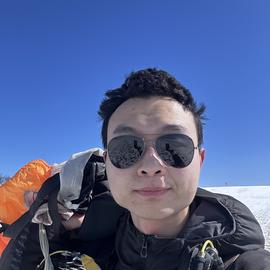
Shang Wu

Shang Wu

PhD Student @ NU

Northwestern University

Biography

I am a Ph.D. student in Computer Science at Northwestern University, advised by Professor Han Liu in the MAGICS Lab. My research focuses on video generation models and world models, especially physically plausible text-to-video generation (e.g., RL-based prompt refinement and physics-consistent 4D modeling), as well as video-language reasoning and flow matching. Previously, I received my M.S. from Rice University and B.S. from The George Washington University, and interned as a Research Scientist at ByteDance GenAI. Outside of research, I enjoy skydiving (USPA B license ✈️) and League of Legends.

Interests
  • Video Generation & World Models
  • Diffusion / Flow Matching
  • Video-Language Understanding
  • Efficient & Robust Deep Learning
Education
  • PhD in Computer Science, 2023-2028 (Expected)

    Northwestern University

  • Master in Electrical and Computer Engineering, 2022-2023

    Rice University

  • BSc in Computer Science, 2018-2021

    George Washington University

Experience


Research Scientist Intern
June 2025 – September 2025 San Jose, CA
Trained and scaled flow-matching text-to-video models; higher-order flow matching for video generation.


Research Assistant
September 2023 – Present Evanston, IL
Video generation and world models; physically plausible text-to-video generation (PhysPrompt, Phys4D).


Research Assistant
May 2021 – May 2023 Houston, TX
Efficient and robust deep learning; ViT robustness and acceleration.


Research Assistant
Adaptive Devices and Microsystems Lab, GWU
January 2019 – May 2021 Washington, DC
Memristive neuromorphic computing.

Selected Publications

(2026). Towards Sparse Video Understanding and Reasoning. In CVPR 2026.

PDF

(2025). High-Order Flow Matching: Unified Framework and Sharp Statistical Rates. In NeurIPS 2025.

(2023). NeRFool: Uncovering the Vulnerability of Generalizable Neural Radiance Fields against Adversarial Perturbations. In ICML 2023.

PDF

(2023). Hint-Aug: Drawing Hints from Foundation Vision Transformers towards Boosted Few-shot Parameter-Efficient Tuning. In CVPR 2023.

(2023). ViTALiTy: Unifying Low-rank and Sparse Approximation for Vision Transformer Acceleration with a Linear Taylor Attention. In HPCA 2023.

PDF Cite Code

(2022). EyeCoD: Eye Tracking System Acceleration via FlatCam-based Algorithm & Accelerator Co-Design. In ISCA 2022.

(2022). Patch-Fool: Are Vision Transformers Always Robust Against Adversarial Perturbations?. In ICLR 2022.

PDF Cite Code

(2021). Drawing Robust Scratch Tickets: Subnetworks with Inborn Robustness Are Found within Randomly Initialized Networks. In NeurIPS 2021.

Publications

(2026). APT: Atomic Physical Transitions for Causal Video-Language Understanding. Preprint.

PDF

(2026). Towards Sparse Video Understanding and Reasoning. In CVPR 2026.

PDF

(2026). Phys4D: Fine-Grained Physics-Consistent 4D Modeling from Video Diffusion. Preprint.

PDF

(2026). PhysPrompt: RL-based Prompt Refinement for Physically Plausible Text-to-Video Generation. Preprint.

PDF

(2026). A Theoretical Analysis of Discrete Flow Matching Generative Models. Under Review.

(2026). Computational Limits of Training Conditional Diffusion Transformers. Under Review.

(2026). Flow Matching Reinforcement Learning via SDE Inference. Under Review.

(2026). GenoArmory: A Unified Evaluation Framework for Adversarial Attacks on Genomic Foundation Models. Under Review.

(2026). Outlier-free SpeechLM with Fast Adaptation and Robust Quantization. Under Review.

(2026). VideoCritic: Diagnosing and Localizing Reasoning Errors in Video-Language Models. Under Review.

(2025). Learning to Feel the Future: DreamTacVLA for Contact-Rich Manipulation. Preprint.

PDF

(2025). High-Order Flow Matching: Unified Framework and Sharp Statistical Rates. In NeurIPS 2025.

(2024). Fast Adaptation and Robust Quantization of Multi-Modal Foundation Models from Associative Memory: A Case Study in SpeechLM. In ICML 2024 Workshop.

(2023). NetDistiller: Empowering Tiny Deep Learning via In Situ Distillation. IEEE Micro.

(2023). EyeCoD: Eye Tracking System Acceleration via FlatCam-based Algorithm and Hardware Co-Design. IEEE Micro.

(2023). Instant-NeRF: Instant On-Device Neural Radiance Field Training via Algorithm-Accelerator Co-Designed Near-Memory Processing. In DAC 2023.

(2023). NeRFool: Uncovering the Vulnerability of Generalizable Neural Radiance Fields against Adversarial Perturbations. In ICML 2023.

PDF

(2023). Robust Tickets Can Transfer Better: Drawing More Transferable Subnetworks in Transfer Learning. In DAC 2023.

(2023). Hint-Aug: Drawing Hints from Foundation Vision Transformers towards Boosted Few-shot Parameter-Efficient Tuning. In CVPR 2023.

(2023). ViTALiTy: Unifying Low-rank and Sparse Approximation for Vision Transformer Acceleration with a Linear Taylor Attention. In HPCA 2023.

PDF Cite Code

(2022). e-G2C: A 0.14-to-8.31 µJ/Inference NN-based Processor with Continuous On-chip Adaptation for Anomaly Detection and ECG Conversion from EGM. In VLSI 2022.

(2022). EyeCoD: Eye Tracking System Acceleration via FlatCam-based Algorithm & Accelerator Co-Design. In ISCA 2022.

(2022). i-FlatCam: A 253 FPS, 91.49 µJ/Frame Ultra-Compact Intelligent Lensless Camera for Real-Time and Efficient Eye Tracking in VR/AR. In VLSI 2022.

(2022). Patch-Fool: Are Vision Transformers Always Robust Against Adversarial Perturbations?. In ICLR 2022.

PDF Cite Code

(2022). LDP: Learnable Dynamic Precision for Efficient Deep Neural Network Training and Inference. arXiv.

PDF

(2021). Drawing Robust Scratch Tickets: Subnetworks with Inborn Robustness Are Found within Randomly Initialized Networks. In NeurIPS 2021.

(2021). Max-Affine Spline Insights into Deep Network Pruning. arXiv.

PDF

(2020). Batch Training for Neuromorphic Systems with Device Non-idealities. In ICONS 2020.

(2019). Attribute-Enhanced De-anonymization of Online Social Networks. In CSoNet 2019.